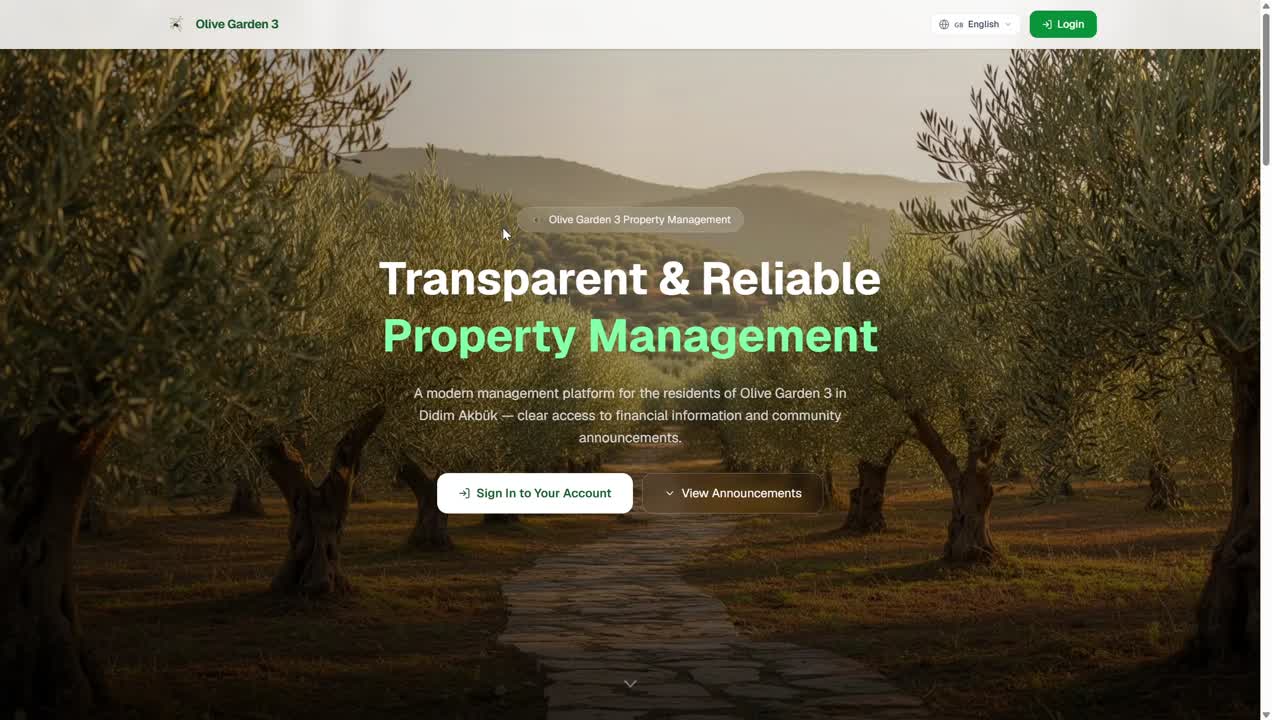
When Taylan's mother became manager of the family's residential complex in Akbük, on the Aegean coast of Türkiye, the job came with a stack of Excel files. There were payments to track, unpaid dues to chase and a yearly budget to organise, and before long the files had become Taylan's problem.
Plenty of people would have tidied up the spreadsheet. Taylan, a 42 Wolfsburg student, built a product instead. What started as a small tool for his mother is now Olive Garden 3, a management platform for the whole complex, running in five languages at olivegardenakbuk.com.
the trouble with paper.
Akbük is a holiday town, and many of the people who own flats there live abroad. The usual way to keep them informed is an annual report on paper. It tends to confuse more than it explains, and an owner living in another country has little choice but to take the numbers on trust. Who has paid? What did the repairs cost? Did the spending match the budget? A printout can't answer follow-up questions.
what olive garden 3 does.
Every owner gets an account. They can log in at any time to see their own dues and payment history, the complex's income and its maintenance spending, read announcements and message the administrator directly. There's a documents area too, where the minutes of the owners' general assembly are posted in Turkish and English, so the decisions behind the budget are as easy to find as the numbers.
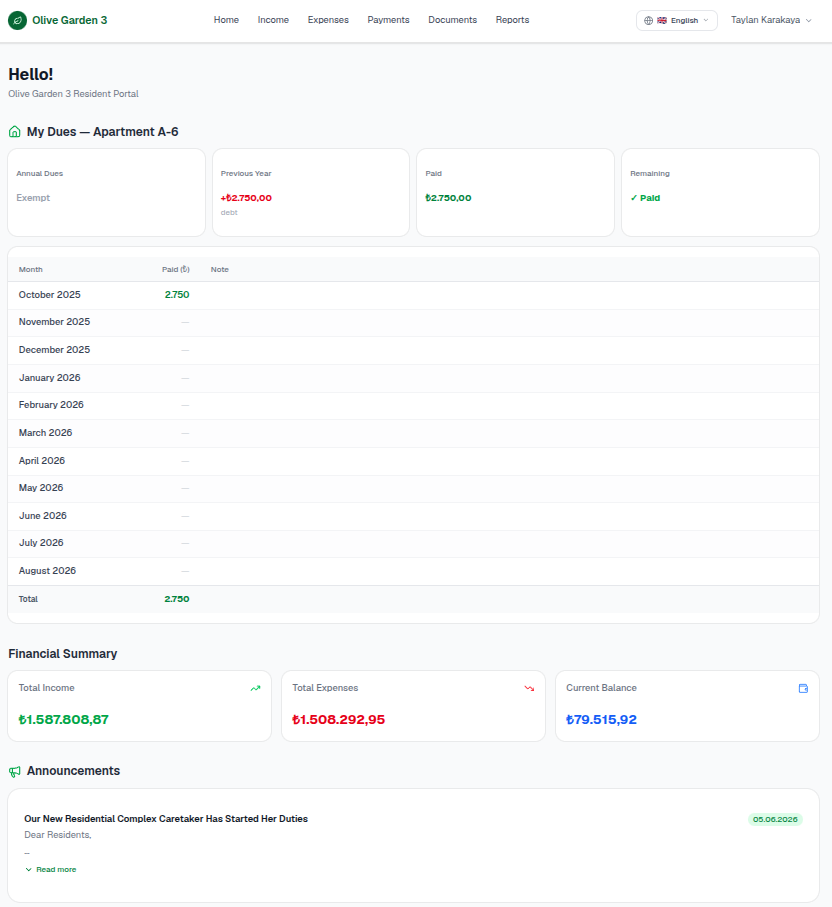
The administrator's side replaces the spreadsheets. It records which flat has paid, how much and when, and flags unpaid dues on its own, so nobody has to check Excel by hand. It tracks income and expenses, and it plans the annual operating budget, filing every expense against the line items the owners' general assembly approved. Only administrators can add or delete records. Everyone else gets to look, which is rather the point.
All of it works in Turkish, English, German, French and Russian, so owners abroad can read it in a language they know.

how it's built.
Taylan built it alone, on tools he had not shipped a product with before. None of them is exotic. Together they make a sensible kit for a small app that has to handle money, logins and five languages without a team behind it.
Next.js and React run the interface. React builds pages out of small, reusable components. Next.js is a framework on top of it that handles routing and the server side. Its App Router turns folders into web addresses, and Server Actions let a form such as "record a payment" write straight to the database from the server, with no separate API to build and look after.
TypeScript keeps the numbers honest. It adds types to JavaScript, so the code knows that an amount is a number and a payment date is a date. In an app full of money, a lot of mistakes get caught in the editor rather than in somebody's balance.
Tailwind CSS and shadcn/ui handle the look. Tailwind styles everything with small utility classes and makes it simple to adapt a layout for a phone, which matters when owners check in from another country. shadcn/ui supplies accessible building blocks such as forms, tables and dialogs, copied into the project so they become part of its own code.
Supabase is the back end. It provides a full Postgres database and user sign-in in one service. Supabase can also enforce access rules inside the database itself, a feature called row level security that works like a filter added to every query. That's the kind of rule an app like this lives on: an owner sees their own dues and nobody else's.
next-intl does the languages. It swaps in the translated text, formats dates and numbers for each language and handles the addresses, which is why the site lives at /en, /de, /fr, /ru and /tr.
The rest is plumbing. Recharts draws the charts in the reports view as ordinary React components, Resend handles email, and Vercel, the company that maintains Next.js, hosts the whole thing. Vercel scales down when nobody is using the app and back up when people are, which suits a user base of a few dozen households.
why 42 made the difference.
Taylan is not new to code. He has a computer science degree from TU Braunschweig, has worked as a developer in Wolfsburg, Braunschweig and, remotely, for a company in Ankara, and is now doing a master's at TU Berlin while working as an AI working student at Dr. Graband & Partner. He joined 42 Wolfsburg in June 2026 and moves to 42 Berlin this month. Lately, in his words, he has been writing a lot of C, which at 42 is not optional.
So what did 42 add? He puts it down to the people around him.
Surrounded by peers constantly building real things pushed me to look at my mother's spreadsheets and see a product.
At 42 there are no lectures. You learn by building, alongside people who are building too, and that changes what a problem looks like. A messy spreadsheet stops being a chore and starts looking like a spec.
a degree and 42, side by side.
Taylan is one of the few people who can compare the two from the inside. At TU Braunschweig, a computer science bachelor's takes six semesters and 180 credits. Most of those come from graded modules with exams, and the compulsory list includes theoretical computer science, algorithms and data structures, and maths. It's a thorough grounding in why things work, taught by people whose job is to teach it.
42 works the other way round. There are no lectures, no teachers and no exams to cram for. The curriculum is a chain of projects that unlock one another, starting in C and moving on to Python, system administration, AI and web development. Nobody explains the material first. You read, try, fail, ask the person next to you and try again, and when a project works, other students check it before it counts. Then you check theirs.
The C matters too. The 42 Piscine and the first projects are written in C, with no framework to lean on, so you learn what memory, files and processes really are. Next.js hides a lot of that, and it helps to know what it's hiding when something breaks at an inconvenient moment.
A degree is good at giving you the map. 42 is good at getting you used to walking without one. Olive Garden 3 needed a bit of both: a data model that holds up, and the nerve to pick up an unfamiliar stack and ship it.
from side project to the people who hire.
42 Wolfsburg opened in 2021 with Volkswagen as its founding partner and is paid for by companies, which is why it costs students nothing. Its strategic partners are Volkswagen, CARIAD, Bayer and New Yorker, with SAP, T-Systems and others supporting, and the full programme includes two internships. According to the school's December 2025 career report, roughly one in five of the roles its students and alumni held were at partner companies.
A project like this one is what makes those conversations easy. It isn't a tutorial or an exercise. It's a live product with real users, built end to end by one person.
software that disappears.
On his own site, Taylan says he cares about software that disappears into the workflow it serves. For a residential complex, that means owners who can check their dues from another country in their own language, and a manager who doesn't have to start the month in Excel.
See the platform at olivegardenakbuk.com and more of Taylan's work at taylankarakaya.com. He isn't the only student here who arrived with a degree, either: Ahsan's story starts the same way. For more like it, browse every story.
42 teaches you to learn anything on your own and to build by doing, so taking on an unfamiliar stack and shipping a full product alone felt normal rather than daunting.
Taylan