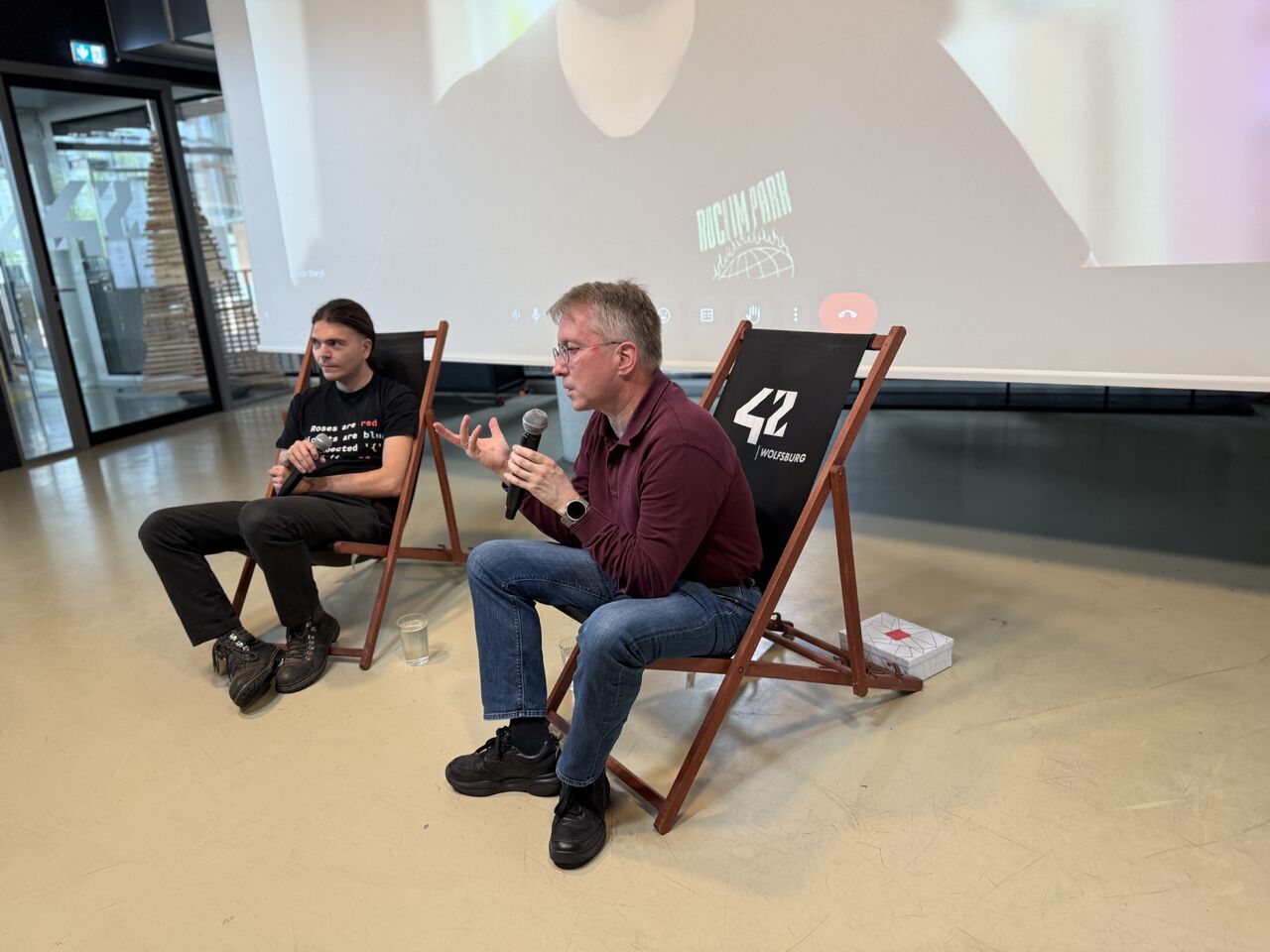
Most of what students learn at 42 Wolfsburg, they learn from each other. That works for code, and rather less well for questions like what a software architect does all day, or how a team behaves when production falls over at four in the afternoon. For those you need people who have been in the room.
So we asked T-Systems to come to campus. They sent four people: Volker Wurst, Senior Software Architect, Barbara Mund, Agile Coach, and two who know the building rather well. Fedir Staryk, DevOps Backend Developer, and Michail Chatzipanagiotou, Senior DevOps Engineer, both studied here before they joined T-Systems.
who came to visit.
T-Systems is Deutsche Telekom's business IT company. According to its own company presentation, it employs more than 25,000 people in 26 countries and works on cloud, security, connectivity and digitalisation for other organisations, with the car industry as one of its focus sectors. It also runs a site in Wolfsburg that works for the car industry.
And it has history with this school. T-Systems says on its careers page that it has worked with 42 Wolfsburg since 2022, and it was among the companies backing 42 Berlin when that campus was set up. The same page says it has taken on several 42 students as interns and that some of them have stayed on in permanent jobs.
the ask me anything.
The first half was an open floor, with no slides and no pitch. Students asked about the things a job advert never tells you: how you move from backend work into architecture, what an agile coach does when a team quietly ignores the process, and whether a DevOps engineer is a developer who got stuck with the servers or something else entirely.
Having two alumni on the panel changed the tone. Fedir and Michail sat in these same chairs before they sat on the industry side of the table, so when they talked about their first months at T-Systems, the room heard a route rather than a story. A career path stays abstract until someone you once evaluated is standing in front of you with a job title.
what a devops engineer actually does.
The answer to that last question is "something else entirely". Amazon Web Services, which sells a lot of the tooling, describes DevOps as a mix of culture, practices and tools that lets an organisation ship software quickly and reliably. In practice, DevOps engineers automate work that used to be slow and manual. They build pipelines that test and prepare every change for release automatically, they describe servers and networks as code instead of setting them up by hand, and they watch metrics and logs so a team can react quickly when something goes wrong.
That last part is why the second half of the session put a DevOps engineer at the centre of the room.
then something broke.
The second half was a case study built around a simulated real-world incident. Something breaks, and a cross-functional team has to work out what happened and what to do about it while the clock runs. Students took the roles a real team would have: the DevOps engineer hunting the fault, the architect asked whether the design allowed for it, the agile coach keeping the group out of circular arguments, and the person who has to explain all of this to someone outside the room.
It got loud, which was the intention. The exercise was less about fixing the fault than about watching how the roles depend on each other under pressure. Most students had read about these jobs, and very few had sat inside one with a deadline attached.
three things that stuck.
Concepts over tools. Languages, platforms and cloud environments change every few years. A deep understanding of fundamentals, such as how containers are built or what a programming paradigm commits you to, is what lets an engineer move between stacks without starting from zero. The tooling is a detail; the thinking is the job.
AI is only as good as the question. The panel was relaxed about AI tools and precise about their limits. A model will happily produce confident nonsense if the prompt is vague. Clear communication, precise questions and the ability to break a problem into pieces are becoming as important as writing the code itself, which is roughly what peer evaluation at 42 trains every week.
Nobody ships alone. The incident exercise made the point better than a talk could. DevOps engineers, agile coaches and architects are the people our students will spend their careers working with. Seeing those roles collide in one room, with a problem that would not wait, taught more than a description of each.
a lecture hall versus a broken server.
The advice to learn concepts rather than tools sounds like something a university would say, and in a way it is. At TU Braunschweig, the nearest technical university, a computer science bachelor's runs to six semesters and 180 credits. At least 120 of those come from graded, examined modules, and the compulsory list includes theoretical computer science, algorithms and maths. You learn a great deal of theory, and you prove it in written exams.
42 is not a university and doesn't pretend to be one. There are no lectures, no teachers and no exams to cram for. Students learn by building projects that unlock one another, starting in C and moving on to Python, algorithms, networks, system administration, AI and the web. A project either works or it goes back for another attempt, and it's checked by other students, who get checked in return. The fundamentals the panel talked about are in there too. System administration, virtualisation and Docker make up a whole module of the core curriculum.
Neither route is better at everything. But a production incident looks a lot more like a 42 project than a written exam: an unfamiliar problem, incomplete information, other people in the room and nobody waiting to hand you the answer.
why we keep doing this.
Industry visits are not decoration here. A school without teachers depends on the outside world to show students where the work leads, and on alumni to prove it can be reached from these desks.
That's also how the school is built. 42 Wolfsburg opened in 2021 with Volkswagen as its founding partner, and it is paid for by companies rather than students, so tuition is free. Its strategic partners are Volkswagen, CARIAD, Bayer and New Yorker, with SAP, T-Systems and others supporting. In their first five years, 42 Wolfsburg and 42 Berlin counted more than 200 of these touchpoints with industry, from hackathons and site visits to workshops and sessions like this one.
The results show up in the numbers. The December 2025 career report from 42 Wolfsburg and 42 Berlin tracked more than 420 students with recorded work experience. Of the 537 roles they held, 60% were permanent contracts, roughly one in five was at an official partner company, and 40 internships had turned into permanent jobs at the same employer.
Two of our own coming back on the T-Systems side of the room did more for that than any brochure. They weren't the only alumni back on campus this autumn, either: Evangelos came back to talk about networking for people who hate networking.
Thank you to the T-Systems International team for spending time on campus, bringing a real scenario rather than a sales deck, and taking the next generation of tech talent seriously enough to let them break things.
Fedir and Michail