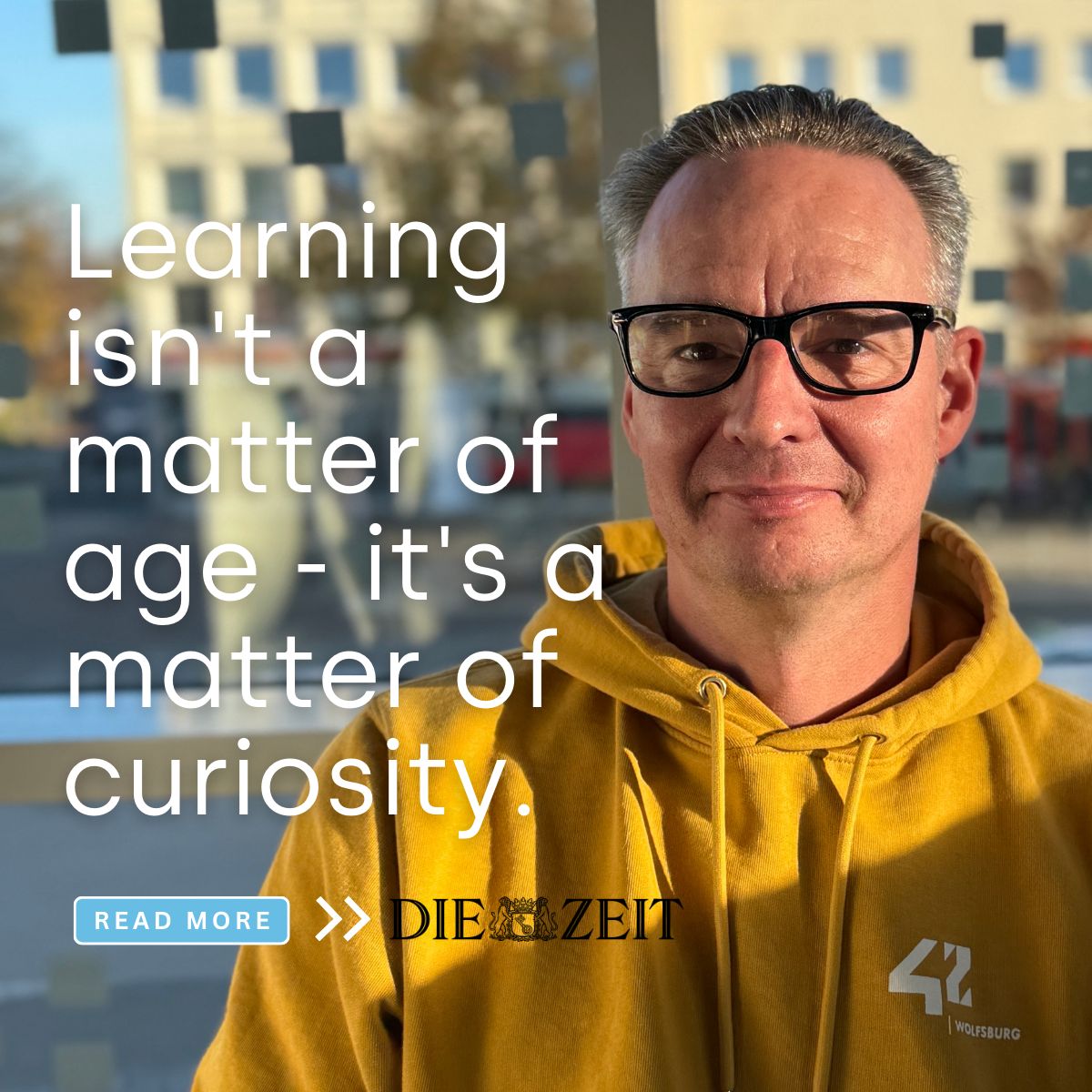
Can you still learn something completely new as an adult? In issue 05/2026, DIE ZEIT set out to answer that. The reporter, Yves Bellinghausen, had started learning the piano at 31 and wanted to know whether his brain was up to it. He spoke to neuroscientists, to an amateur pianist who started in her fifties, and to a student at 42 Wolfsburg: Jan Claas, a carpenter who started learning to code at nearly 50.
a back that said no.
Jan Claas is a trained carpenter from the Lüneburger Heide. For years he restored old buildings, converted lofts and built terraces. He carried beams on his shoulder and hauled plasterboard up the stairs, until one day in 2023 a pain shot into his back without any warning. The orthopaedist diagnosed a slipped disc.
He asked the doctor what would happen to him now. The answer, as he told DIE ZEIT, was a question: did he know a single person on a building site who didn't have back pain?
He was in his mid-forties. It became clear that he wouldn't be able to work on building sites until retirement. It's a familiar risk in his trade: in construction, lumbar disc disease caused by years of heavy lifting is a recognised occupational illness, according to BG BAU, the industry's accident insurer.
First came the shock, then, as DIE ZEIT put it, the chance to reinvent himself. A desk job in a master craftsman's office sounded too boring. A business degree sounded too much like school. What he had always loved was computers. When he was in his early twenties he hadn't had the confidence to study computer science. At nearly 50 he did.
why a carpenter picked 42 wolfsburg.
He did some research and found 42 Wolfsburg, an hour and a half from home. The model suited him. Anyone can apply, whatever they did before. Tuition is free, because companies pay for the school. And nobody lectures: students learn from each other, by building projects.
That openness isn't marketing. To apply to 42 Wolfsburg you need to be 18 or older, and that's the whole list. There's no upper age limit, and you don't need a degree or any coding experience. Everyone starts with the 42 Piscine, a 26-day coding sprint that assumes you know nothing. Jan Claas applied and got in.
Since then I've been working on reprogramming my own brain.
That's how he described it to DIE ZEIT, over a cappuccino in the glass-walled break room above Wolfsburg's city centre. Learning to code at 50, he said, meant learning to think like a computer.
errors you can't see.
On a building site, his thinking was physical. He could see a mistake in an untidy joint, hear it in a squeaking hinge, feel it in the weight on his arm. Code doesn't give you any of that. The errors stay silent and hide somewhere in the lines. So he had to learn to sit patiently in front of a screen and hunt for breaks in the logic, through branching decision trees where one misplaced bracket stops everything.
At first, he told DIE ZEIT, the new way of thinking felt cold and unwelcoming. It wasn't easy at his age either. Some days, after eight hours, his brain was simply mush, and at some point he had to go home to his family. He watched the 18-year-olds who, in his words, do nothing but drink coffee, code and sleep. He's sure they'll build AI models one day. For himself he could picture a future as a system administrator.
feedback from someone half his age.
The best scene in the article happens in the cluster, the open room on campus where more than a hundred computers stand side by side and students sit in small groups, arguing about their code. Jan Claas was working on a small address book in C++, about 300 lines long, and asked the student next to him to take a look.
His neighbour rolled his chair over and went through the code. He found that the input loop didn't check the stream state properly. Then he showed that a stray space or tab could break the table, so it needed a whitespace check. Jan Claas took notes. He hadn't thought of that, he said, and asked whether there was anything else. The answer was that everything else was great.
That's how learning works at 42. There are no teachers and no lectures. Every project is checked by other students, and you check theirs in return. For a carpenter it's a familiar idea turned upside down. On site the person with experience checks the apprentice's work. In the cluster, a father of two with a journeyman's certificate was having his practice project reviewed by someone young enough to be his son.
The reporter admired the good-humoured gratitude he took it with, and that became the point of the whole article. The longer he looked into the question, the less he believed that an ageing brain stops adults from learning. What matters more, he concluded, is whether you're willing to make yourself small again. At some point in adult life you get used to knowing how things work and telling other people. To learn something new you have to swap roles, accept that you don't know, and take advice instead of giving it.
what the science says about learning as an adult.
The neuroscientist Gerd Kempermann, who wrote the book Die Revolution im Kopf (Droemer, 2016), told DIE ZEIT that scientists now agree the brain keeps developing throughout life. The idea of the rigid adult brain, he said, has mainly stuck in public opinion. In his view, adults fail at the learning format more often than at the learning itself. Children's lives are built around learning, and an adult with a full-time job and a family is rarely set up that way.
Adults also bring things children don't, he said: more general knowledge, a better grasp of how things connect, a sense of which learning methods work for them, and usually more discipline. Ageing, as he put it, is winning and losing at the same time.
The research the article draws on points the same way:
- London taxi drivers who passed "The Knowledge", the city's famously hard street exam, grew grey matter in the posterior hippocampus, the brain's map room (Woollett and Maguire, Current Biology, 2011).
- At the Max Planck Institute for Human Cognitive and Brain Sciences in Leipzig, 59 adult Arabic speakers learning German intensively for six months showed stronger connections in their language network, as the institute reported in 2024.
- At the Hanover University of Music, Drama and Media, the researcher Florian Worschech gave older adults with little or no musical background a year of piano lessons. The part of the brain that processes sound became measurably thicker.
None of this makes learning at 50 effortless. It does mean the brain isn't the obstacle people assume. At 42 the format is unusual too: no timetable and no lectures to keep up with, a campus that's open around the clock, and projects you finish at your own pace with help from whoever is sitting next to you. We like to think that's part of why it works for late starters.
a hackathon in hamburg.
Learning to code at 50 doesn't mean staying in the cluster. In April 2026, Jan Claas and four other students from 42 Wolfsburg and 42 Berlin went to Hamburg for the ChefTreff AI Hackathon at the Future Leader Summit: 24 hours of building in small teams, with real challenges set by companies.
Their team, 42WOBER, took on the challenge from Finanz Informatik. The brief was about the gap between business and tech, and the team built a prototype that uses generative AI to explain code changes to people who don't write code. It's a fitting job for someone who has only recently learned to read code himself. The lesson the students brought home was a sober one: AI is a powerful collaborator, but it won't replace a developer's core logic and architectural thinking any time soon.
is 50 too late for a career change into tech?
Not on the evidence: Germany still has 79,000 unfilled IT positions, according to the digital association Bitkom in September 2026. In a separate Bitkom survey, 69% of companies with IT positions said they employ career changers, known in German as Quereinsteiger. Among those companies, 47% employ people whose original vocational training had nothing to do with IT, and half of all companies with IT jobs say practical skills now count for more than formal qualifications.
That's encouraging, but we'll be honest about the rest. 42 Wolfsburg isn't a university and doesn't award a state-recognised degree. Graduates get a certificate of completion and the skills to back it up. The core curriculum takes most students around a year and a half, and it asks a lot of people with jobs and families. Jan Claas knows that better than anyone.
He isn't the only person here who changed direction, either. Pooneh was a chemical engineer before she became a backend developer at Delivery Hero, and Ahsan came to 42 with a degree and left for a job at New Yorker.
The full DIE ZEIT article on learning as an adult is on zeit.de and sits behind the paywall. If you've been telling yourself it's too late to learn to code, it starts with the 42 Piscine, and there's no age limit at the door.
Jan Claas